Category: knowledge
-
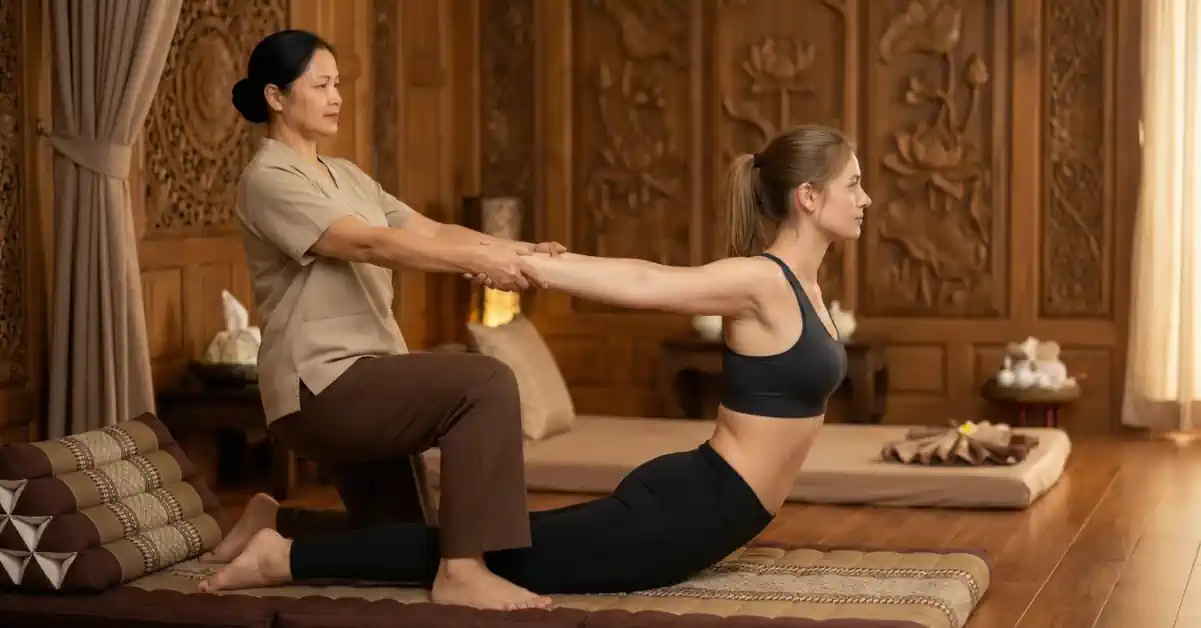
Thai massage and stretching: the art of “lazy yoga”

Traditional Thai massage blends acupressure, compression, and assisted yoga stretches for a transformative experience. Often called “lazy person’s yoga,” it uniquely enhances flexibility without your effort Read more
-
Your neck pain might stem from “Turtle Neck”
Forward Head Posture (FHP), or “Turtle Neck,” causes chronic neck pain, headaches, and sleep issues from gadget overuse and poor posture – leading to upper crossed syndrome and dowager’s hump. Professional massage targets deep fascia to restore balance, break adhesions, and prevent irreversible deformity through targeted rehab Read more
-
Heat and massage: why they work better together
Heat is a powerful, natural tool for recovery. By softening the tissues and quieting the nervous system, it turns a standard massage into a deep, restorative experience that lasts long after you leave the table Read more
-
Maintain brain function and prevent dementia by head massage
Maintaining brain function and preventing dementia can be supported through targeted self-massage of specific acupressure points on the head and neck. The key combination includes the central Baihui point, the four surrounding Sishencong points, and the basal Fengchi point. Stimulating these acupoints promotes better blood circulation to the brain, enhances Qi flow, clears the mind,… Read more
-
Should Thai massage be painful?
Thai massage can be strong and at times a little uncomfortable, but it should never be painful. Its purpose is to leave you relaxed, more flexible, and full of energy – pain is not a sign of success Read more
-
Sooth sore legs and feet with 4 pressure points
The discomfort of sore legs and feet, including knee stiffness, thigh pain, calf cramps, and ankle swelling, can be relieved through self-massage of specific acupressure points. The effective combination of Xuehai, Fengshi, Chengshan, and Shangqiu, located on the thigh, outer thigh, calf, and ankle, respectively, targets these areas to restore Qi flow and alleviate pain.… Read more
-
How often should you get a massage?
You may receive an oil-based relaxation massage or an Eastern foot massage on a daily basis if desired. However, for Thai and other types of Eastern energetic massages, it is advisable to allow at least 2–3 days between sessions. The frequency of remedial massages depends on the severity of the condition and individual needs. Read more
-
Japanese Okido Yoga: healing through movement and self-massage
Japanese Okido Yoga is a holistic health system that integrates Indian Hatha Yoga, Chinese medicine, Zen philosophy, and Japanese martial arts Unlike classical Indian yoga’s spiritual focus, Okido Yoga promotes physical, mental, and spiritual well-being through dynamic, playful movements, partner exercises, and self-massage techniques. Read more
-
Calf self-massage (hogushi) in Japanese Okido Yoga
In traditional Chinese medicine and Japanese Okido Yoga, calf massage is a vital practice for restoring energy flow through the Bladder and Kidney meridians, which regulate vitality, toxin elimination, and emotional balance. Okido Yoga’s self-massage (hogushi) stimulate these meridians to alleviate tension and promote holistic well-being. Read more
-
Calf muscles are the “second heart” of your body
The calf muscles act as a pump to push oxygen-depleted blood from the legs back to the heart, countering gravity’s pull. However, prolonged immobility increases the risk of poor circulation, leading to symptoms such as swelling, numbness, cold feet, and serious conditions like varicose veins or deep vein thrombosis, a potentially life-threatening blood clot. Read more