

The discomfort of sore legs and feet, including knee stiffness, thigh pain, calf cramps, and ankle swelling, can be relieved through self-massage of specific acupressure points. The effective combination of Xuehai, Fengshi, Chengshan, and Shangqiu, located on the thigh, outer thigh, calf, and ankle, respectively, targets these areas to restore Qi flow and alleviate pain. Incorporating these acupressure techniques into your daily routine can promote greater comfort and mobility.
Sore legs and feet can stem from prolonged standing, intense physical activity, or poor circulation, leading to discomfort in the knees, thighs, calves, or ankles. This can manifest as aching, tightness, or swelling, impacting mobility and overall well-being.
In traditional Chinese medicine (TCM), leg and foot pain is often linked to blockages or imbalances in the flow of Qi, the body’s vital energy, particularly along the Spleen, Kidney, and Liver meridians. These meridians govern muscle strength, circulation, and energy distribution in the lower body.
In TCM, restoring smooth Qi flow through targeted acupressure can alleviate pain, reduce inflammation, and promote relaxation in the affected areas. If you’re unable to consult a TCM practitioner to pinpoint specific imbalances, a sequence of acupoints targeting common areas of leg and foot discomfort can serve as an effective, side-effect-free remedy.
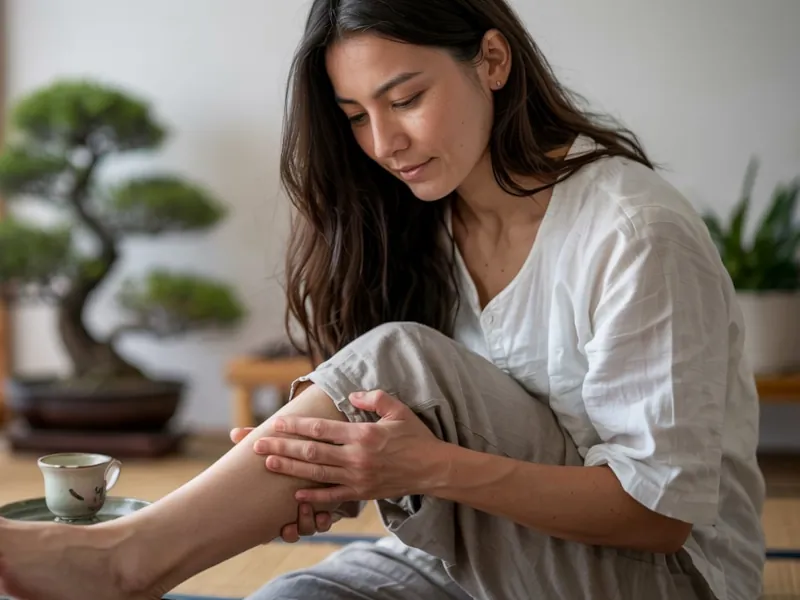
Below is a sequence of four acupoints designed for self-massage to soothe sore legs and feet. Follow the order carefully, starting at the thigh and moving down to the ankle, to encourage optimal Qi flow and relieve discomfort holistically.
Here’s the step-by-step sequence:
1. Xuehai – for sore knees
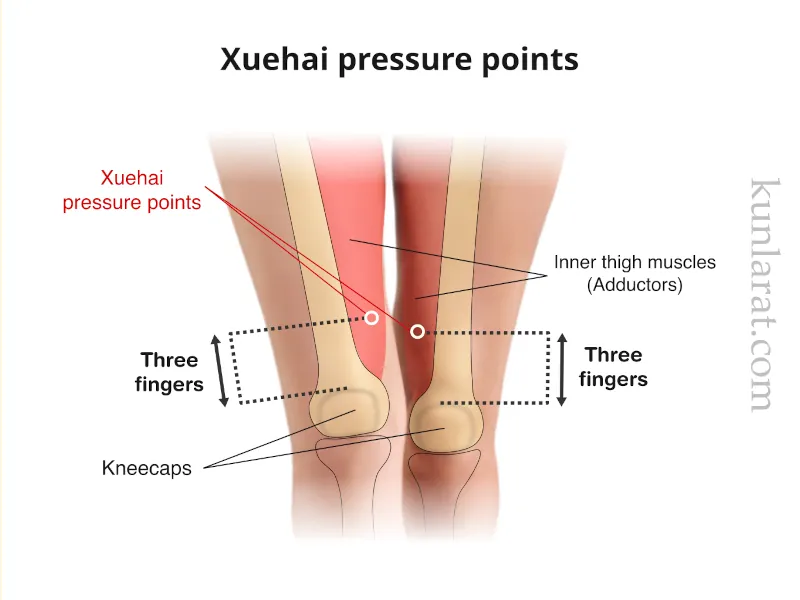
Xuehai, or “Sea of Blood,” is located on the thigh and is renowned in TCM for improving blood circulation and relieving knee pain. It supports the Spleen meridian, which governs muscle and joint health, making it ideal for addressing soreness or stiffness in the knees.
How to find Xuehai
Sit with your knees slightly bent. On the inner thigh, place your palm just above the top edge of your kneecap. Xuehai lies about three finger-widths above the knee, in a slight depression on the inner side of the thigh muscle.
How to massage Xuehai
Use your thumb or knuckles to apply firm, steady pressure, massaging in small, circular motions for 1-2 minutes on each leg. Breathe deeply to enhance relaxation.
2. Fengshi – for thigh pain
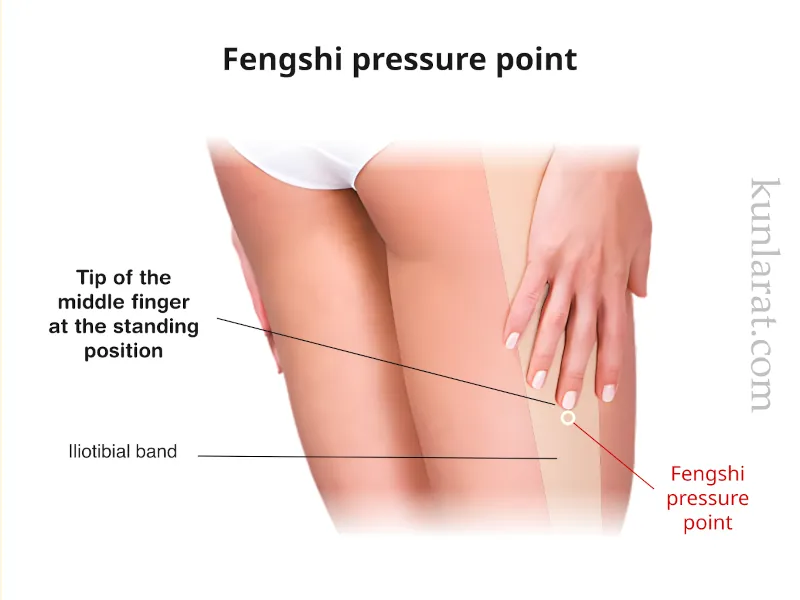
Fengshi, or “Wind Market,” is found on the outer thigh and is associated with the Gallbladder meridian. It’s used to relieve muscle tension, shooting pain, and heaviness in the thighs and hips.
How to find Fengshi
Stand naturally and let your arms hang down at your sides. The point is located where the tip of your middle finger touches the outer thigh. Press around this area until you feel a sensitive spot – that’s Fengshi.
How to massage Fengshi
Apply gentle, circular pressure with your thumb or index finger for 1-2 minutes on each leg. Use moderate pressure to avoid discomfort, focusing on slow, deliberate movements.
3. Chengshan – for calf pain
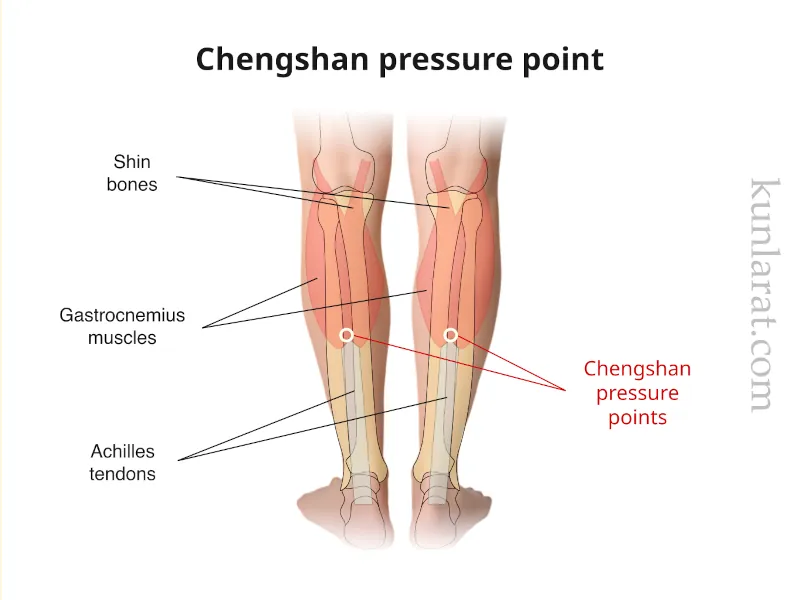
Chengshan, or “Mountain Support,” is located on the calf and is linked to the Bladder meridian. It’s highly effective for relieving calf pain, cramps, and tension, as it promotes Qi flow and relaxes the muscles in the lower leg.
How to find Chengshan
Sit with your leg extended. On the back of your lower leg, look for the point where the calf muscle splits into two bundles—about halfway between the back of the knee and the heel. The spot feels like a hollow when you press into it – this is Chengshan.
How to massage Chengshan
Use your thumbs to press upward into the hollow with steady pressure. Massage in small circles for 1–2 minutes on each leg, or hold the point for 5–10 seconds before releasing and repeating. If the area feels tight, start with lighter pressure and gradually increase as the muscle relaxes.
4. Shangqiu – for ankle pain
Shangqiu, or “Merchant’s Hill,” is located near the ankle and is associated with the Spleen meridian. It’s excellent for relieving ankle pain, swelling, and stiffness, as it supports circulation and reduces inflammation in the lower extremities.
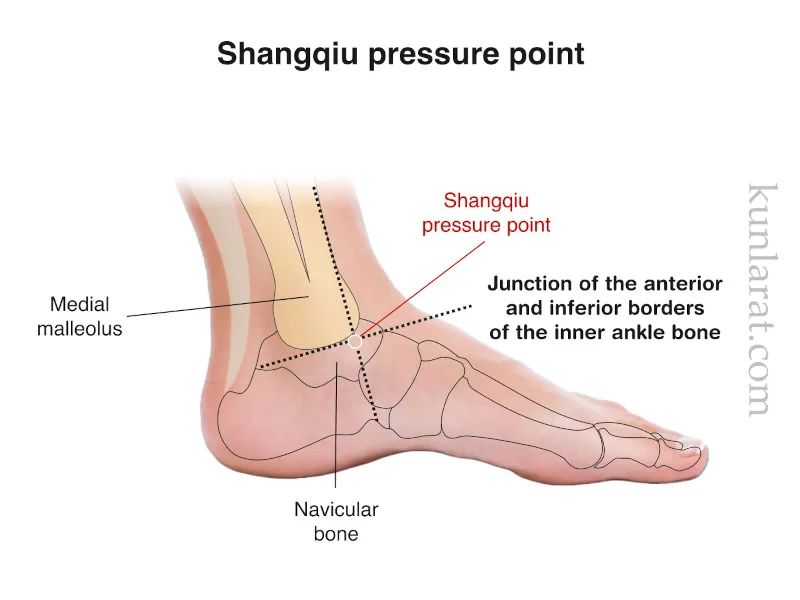
How to find Shangqiu
Locate the inner ankle bone (medial malleolus). Shangqiu is in the depression just below and slightly in front of the ankle bone, where your finger naturally rests when pressing gently.
How to massage Shangqiu
Use your thumb or index finger to apply gentle, circular pressure for 1-2 minutes on each ankle. Focus on slow, steady movements to promote relaxation and reduce swelling.
General guidelines for self-massage
- The thumb and index finger are best suited for pressure, but you can use any other finger.
- Be gentle and avoid excessive pressure. You should never feel pain, but some tenderness is natural and positive. Gradually increase the pressure over time to allow the muscle tissue to relax. If there is no muscle tissue at the point, simply increase the pressure in the same manner.
- Start slowly and massage in circles initially. You can apply steady pressure and hold until you feel a “good pain,” or use a pattern of holding the pressure for 5 seconds and then releasing it for 1 second.
- Press on each point for about 2-3 minutes. Then perform the sequence on the corresponding point on the other side of the body.
- If your hand gets tired from applying pressure, pause and shake out your hand.
- Deep, slow breaths enhance the effectiveness of acupressure.
- Practice regularly for best results. You can perform this technique 2-3 times per week or daily.
By following this sequence—starting from the thigh to improve circulation, moving to the calf to release tension, and ending at the ankle to reduce swelling—you can effectively address leg and foot soreness in a holistic way. This routine can be done daily to maintain comfort and mobility.